Bumblebees? – I thought it was all about the honey bee. I was wrong….
I recently attended a Conference hosted by the Bumblebee Conservation Trust at Royal Holloway University in Surrey.


There are 250 known bee species in the UK; 225 of these are solitary bees, 24 of them bumblebees and just one species of honey bee.
The common carder is the only common UK bumblebee that is mostly brown or ginger.
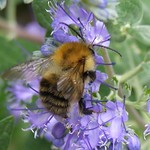
Perhaps surprisingly surveys indicate that honey bees comprise only 2 – 3 % of visits to flowers. Bumblebees are very efficient pollinators and they are the main pollinators for commercial pea and bean crops. Their size and hairiness mean that they have both; more contact with the stigma of the flower and more pollen sticks to them. Bumbles are not hoarders like honey bees so they have to be out every day, early and late in the year, collecting pollen for their grubs. In fact some British Bumblebee species are out and about nectaring right through the winter. Consequently they are endothermic, meaning they can generate their own body heat and are specially adapted to cool, wet climates.
They are used commercially in soft fruit production and are known to have a positive impact both on yields and the quality of the fruit. Economists in the US have started putting million dollar figures on Bumbles contribution to the National Economy.


These solitary bees above nest in holes collecting mud and using it to ‘plug’ the end to protect their eggs. They also have a significant role in pollinating both our food crops and wild flowers.
 In recent decades the geographical area where bumblebees occur has declined by over 70% and their abundance by more than 75% – why?
The most likely reason for this massive decline is a lack of pollen and nectar for food especially at the beginning and end of the year (March – October) when commercial flowering crops such as oil seed rape have been harvested and their nectar is no longer available. It in these periods when availability of food is low that wild flowers ‘fill the gap’ providing essential pollen and nectar at key times of the year. An estimated 97% of our flower rich grasslands have disappeared.
Different species of bumblebees favour different species of flowers – bumbles have differing tongue lengths and tubular flowers favour longer tongues. The loss and decline of harebell and sheeps bit scabious is associated with the decline of specific bumblebee species.
It was noticed that flowers from the pea family – clovers and vetches seemed to be the most attractive to bumblebees and it has been discovered that these plants have the most high levels of protein in their pollen and nectar.
What can we do at Home Farm Marsh for Bumblebees?
There were some inspiring examples of managing farms to encourage bumblebees, as well as for other nectar and pollen loving insects. There has been enough research to formulate best practice and much of what is already being done at Home Farm Marsh is benefitting bumblebees.
Several smaller 0.25 ha (0.6 acre) areas of high yielding pollen and nectar plants is better than one bigger area. The Bumblebee Conservation Trust suggests having field margins 6 metres by 400 metres around a farm. These strips need to be on the south side of hedges for maximum warmth and sunlight.
 The famous picture gallery at Royal Holloway has a dozen or so paintings of pastoral and rural scenes and it is interesting to note how many of them show small areas of unkempt ground where plants have been left to grow and flower. Our modern farms tend to be very clean and tidy environments and unmanaged areas tend to have very high levels of nutrients that make them unsuitable for wild flowers. We need to find ways to recreate these areas of colour and biodiversity. Urban gardens are something that most of us can have an immediate impact on and the Bumblebee Conservation Trust has some great advice for those wanting to increase Bumble numbers.
 There was some disagreement about whether it is better to establish specific pollen and nectar seed mixes or if more general wildflower mixes are better. In April this year we planted a pollen and nectar mix at Home Farm Marsh with limited success. Several experts at the Conference confirmed, not only the difficulty of establishing these plant mixes, but also their limited life span of 2 or 3 years. Wildflower mixes are easier to establish and last 10 years or more.
We are planting a wildflower meadow in April in Gutter Marsh field and hope that this will provide abundant nectar and pollen for our many pollinators. Home Farm Marsh is 80 hectares and could support 40 bumblebee colonies.
Anyone wanting to take part in surveying for Bumblebees at Home Farm Marsh or the other Reserves in Cornwall can get in touch with the Gaia Trust


 One of 4 shallow scrapes that will hold water over the Winter months
 These large rangy hawks are on passage between their breeding grounds further north and Africa where they see out our winter. Research shows that they have favoured migration routes that they stick to throughout their lives.


